U.S. Beef Trade and the Decline in Cull Cow Markets
James Mitchell, Ph.D.
Assistant Professor & Extension Economist, Department of Agricultural Economics & Agribusiness, University of Arkansas
USDA-ERS recently published U.S. meat and livestock trade data through September 2026. Importantly, this includes beef import totals for the first month of the Trump Administration’s expanded tariff-rate quota for imported lean beef trimmings. September 2026 beef and veal imports totaled 567.2 million pounds, up 9.1% from August 2026 and 49.7% higher than September 2025. September 2026 beef and veal exports totaled 179.9 million pounds, 9.0% below the month prior but 0.3% higher compared to September 2025. Year-to-date U.S. beef imports total 4.926 billion pounds, 17.5% above the same period last year, while exports total 1.754 billion pounds, 11.5% below last year.
Beef imports more closely compete with domestic processing beef and is blended with 50 lean beef trimmings to produce ground beef. This is important to acknowledge because it implies that beef imports undergo further processing and added cost before reaching consumers. Meaning, more beef imports does not immediately mean lower ground beef prices for consumers.
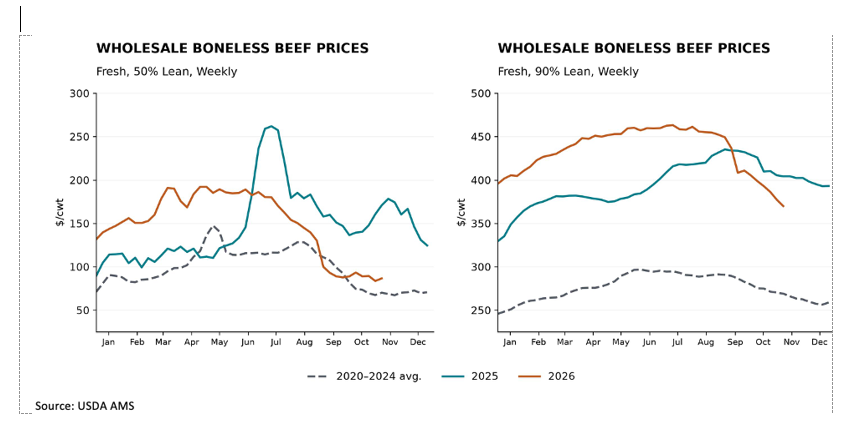
USDA-AMS reports weekly wholesale prices for 50% and 90% lean beef trimmings. For the week ending November 6, wholesale fresh 90% lean beef averaged $369.98/cwt, down 20.1% from its July 10 peak of $463.22/cwt. Fresh 50% lean beef averaged $86.62/cwt, down 54.9% from its May 1 peak of $192.11/cwt.
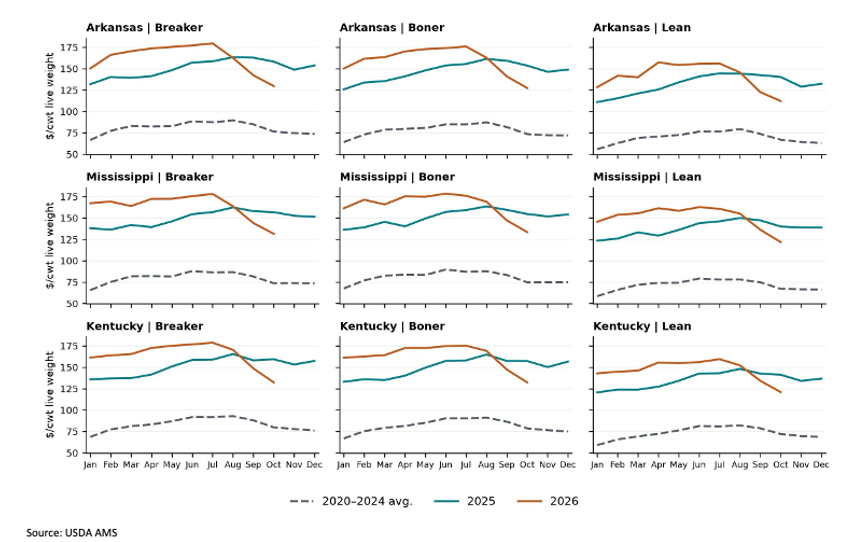
The normal seasonal price pattern for cull cows is for prices to increase through the spring and summer before declining in the fall. The second figure in this article shows monthly average prices for breakers, boners, and lean cull cows in Arkansas, Mississippi, and Kentucky. These are USDA-AMS marketing classifications that correspond to body condition scores of 7 to 9 for breakers, 5 to 7 for boners, and 3 to 5 for lean cows. Prices in 2026 were above 2025 levels through the first half of the year, then fell sharply from late summer through October. October boner prices averaged $127.23/cwt in Arkansas, $133.39/cwt in Mississippi, and $132.22/cwt in Kentucky, compared with July averages near $175–$176/cwt. Breaker and lean cow prices followed a similar decline in each state.
The decline in cull cow prices this fall has been larger than the normal seasonal price pattern. From July to October, prices across the three grades and three states fell 24% to 28%, compared with average declines of 12% to 14% during 2020-2024. These price declines reflect impacts from larger beef imports but also local drought conditions as well which have been impacting the region throughout 2026.
The Markets
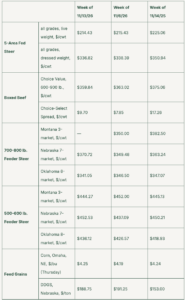
Data Source: USDA-AMS Market News as compiled by LMIC